Questrom Team Learning
Student Resources
Advancing the Team
Set Your Team Up for Success
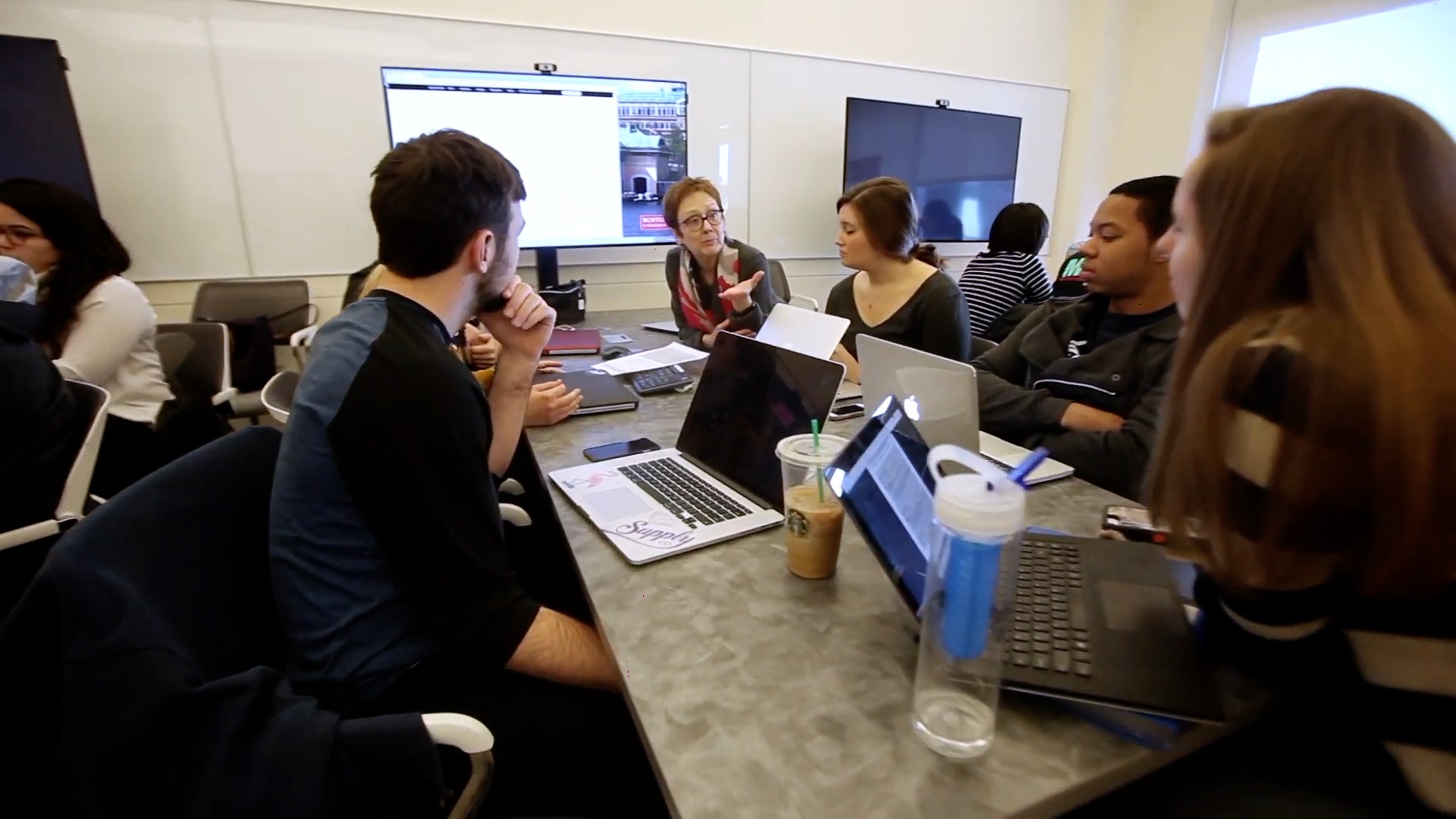
Effective teamwork requires that all team members work interdependently to accomplish the team’s goals. Team members collaborate, depend on, and are accountable to each other. However, interdependence does not mean that everyone is doing the same things. You can’t have a hockey team where everyone plays goalie – you need different players, in different positions, with different responsibilities – all working together, understanding where their roles and responsibilities begin and end. That is interdependence.
In order to do that well, teams need to establish clear systems and structures to guide performance. Once you have had a chance to get to know your teammates, your team needs to discuss what you intend to accomplish, how each member can contribute, and how you plan to communicate, share information, and work together. In other words, you need to create a working agreement that explicitly addresses how your team will work interdependently to achieve its goals.
Team Contract … GRPI+
Goals, Roles, Processes, Interactions, +Plan/Schedule
The GRPI Team Contract is a useful model to guide teams as they structure their goals and expectations for performance. Key elements of the GRPI contract include Goals, Roles, Processes, and Interactions. In addition, the team should create a working project plan or schedule that includes team deadlines as well as course or project deadlines. Each is explained below.
GOALS
Using the work that has been assigned to the team as a starting point, teams should set clear goals for what they would like to accomplish together. Each team member should have a voice in the goal-setting process so that each member is committed to achieving the same objectives. Watch the Goals video to understand the importance and practice of goal-setting for teams.
Examples of SMART Goals
Individual Goals
Team Process Goals
Team Task Goals
Ideas to Include – Team Goals
Ethical Practices
Engagement
Group decisions
ROLES
Just like a sports team or a music ensemble, each member of your team has an important role to play. Your job as a team is to determine the necessary roles for task completion, project management, team communication, and other essential duties. Then describe and define each role so that all members are clear on what the role requires. Team members should select roles based on their talents or strengths, or when they want to learn a new skill or acquire new knowledge. Take a few minutes to watch the video to learn more about establishing roles on your team.
What am I Good at ? What do I want to Develop ?
Task Roles or Process Roles
Ideas to Include – Define Roles
Agenda Manager
Agenda Manager will create the meeting agenda based on input from team, and send out meeting invitations with agenda included.
Secretary
Secretary – will take meeting minutes, highlight action items and distribute following each meeting. Is responsible for organizing shared documents in team drive.
Moderator
Moderator – facilitate discussion during team meetings, ensuring that all team members contribute to discussions and decisions, responsible for making sure meeting is making forward progress.
Devil’s Advocate
Devil’s Advocate – has the responsibility to develop counter arguments for all major decisions faced by the team in order to address the danger of groupthink.
PROCESSES
The team should clarify processes and procedures regarding how the team will organize and manage its work, including methods and expectations for communication (e.g., virtual, face-to-face, texting, emails, etc.), as well as processes for collaboration, problem-solving, decision-making, and conflict resolution. Watch the video to learn more about establishing important team processes.
Questions to Ask Yourselves
WHY are we gathering?
WHAT is the goal of each meeting?
WHEN do we meet?
WHERE do we want to meet?
WHO is coming to the meeting?
HOW do we want to meet?
HOW should we make decisions?
HOW will we resolve conflicts?
HOW will we define roles?
Main Concepts to Consider
Decision Making Process
Minority, Majority or Consensus?
Whenever possible, teams should strive for consensus decisions. That means that all members agree to the final decision, even if that decision was not their first choice. Consensus decision making builds commitment to the decision and engenders buy-in from team members. Reaching consensus takes time, however. Teams that must move more quickly to a decision will often use majority rules as the decision process (i.e., voting). While this process can save time, it leaves people out of the process when they don’t agree with the decision, and that comes at a cost. Members who are consistently “out-voted” can lose motivation and commitment to the team’s objectives. Finally, teams should be wary of decision making by “minority rules” – as happens when one or two team members make decisions on behalf of the team. This leaves too many people out of the decision making process, and can lead to one or two vocal members dominating team decisions.
Communication Channels
Choose communication tools that you will use


There are many tools that teams can use to communicate with each other and to track work progress. The key is to choose tools that team members will use frequently and consistently. Consider tools that will enable timely communication, document sharing and tracking, co-creation of work products, and the ability to provide feedback.
Conflict Management
What is the process when facing conflicts?
Teams should think carefully about the processes that that will follow when conflicts arise, as disagreements are an inevitable – and desirable – outcome of teamwork. When team members share different ideas, advocate for divergent views, and offer differing perspectives on the team’s path forward, the team has the ability to engage in constructive conflict and choose the best options for collaboration. However, destructive conflict can derail teams, and must be dealt with professionally and effectively. Teams should agree to a process for managing conflicts – in advance – as part of their contracting process. For example: teams can agree that conflicts will be discussed face-to-face (in person or online), rather than via text, email, or other electronic messaging; teams can choose to assign the role of mediator to a team member who is skilled at conflict mediation.
Ideas to Include on Team Contract
Meetings
Communication & Scheduling
Managing Conflict
INTERACTIONS
Team members should also discuss their expected interpersonal interactions and professional behavior within the team. Explicitly addressing expectations for treating each other with respect, attending and participating in team meetings, interacting professionally, handling diverse views, experiences and perspectives, and adhering to professional standards of conduct, allow teams to build healthy and supportive relationships as well as manage conflict and performance effectively. View the video to learn more about how to discuss team interactions that will set your team up for success.
Communication Skills
Effective collaboration requires excellent communication among team members. You have an opportunity to build your communication skills as you work with your team to accomplish your goals. View the Ted Talk below by Julian Treasure for more information on how to improve your communication by speaking in ways that make others want to listen.
The Power of Listening
“Listening is our access to understanding.”
Learn to become a better listener – to build your ability to understand and connect with others. In the following Ted Talk, Julian Treasure provides you with tools to improve your listening skills.
Giving Great Feedback
Improve your ability to deliver great feedback – feedback that inspires, improves performance, and builds team commitment. In this video, LeeAnn Renninger teaches you The Secret to Giving Great Feedback by discussing a few simple yet powerful actions you can take to build your feedback skills.
Ideas to Include on Team Contract
Professionalism
Our team is determined to make sure that all interpersonal interactions are executed in an agreeable, professional, and respectful manner. During meetings, all team members will be encouraged to openly participate, with engaged listening from everyone.
Managing Conflicts
Feedback
+PLAN/SCHEDULE
+ Teams also need to break their work down into discreet elements with clear interim deadlines. Agree to a schedule for meetings, identify team deadlines for work, and note course deadlines for key deliverables. The more explicit the team can be in planning their work and their schedule, the better.
Ideas to Include on Team Contract
Team deliverables
Our team will hand-in each individual part a day before we meet so that each member has a chance to review.
Ask for help
If a team member has situations and needs help from others, he/she will reach out to another team member at least three days before the team deadline.
Deadlines and due date
Our team will set up our final deadlines at least a day before the assignments/projects due date.
Best Practices for Managing Team Performance
Once you have set up your Team Contract, use it as your guide to managing the teamwork. Beyond the contract, however, you can click the link below to find more resources and best practices for managing your team performance, including tips to make meetings more efficient, best practices for giving and receiving feedback, and advice for managing conflicts and challenges on the team.