
Hello

Self-Employed Women’s Association 2014 – First Week with Jamie Kim
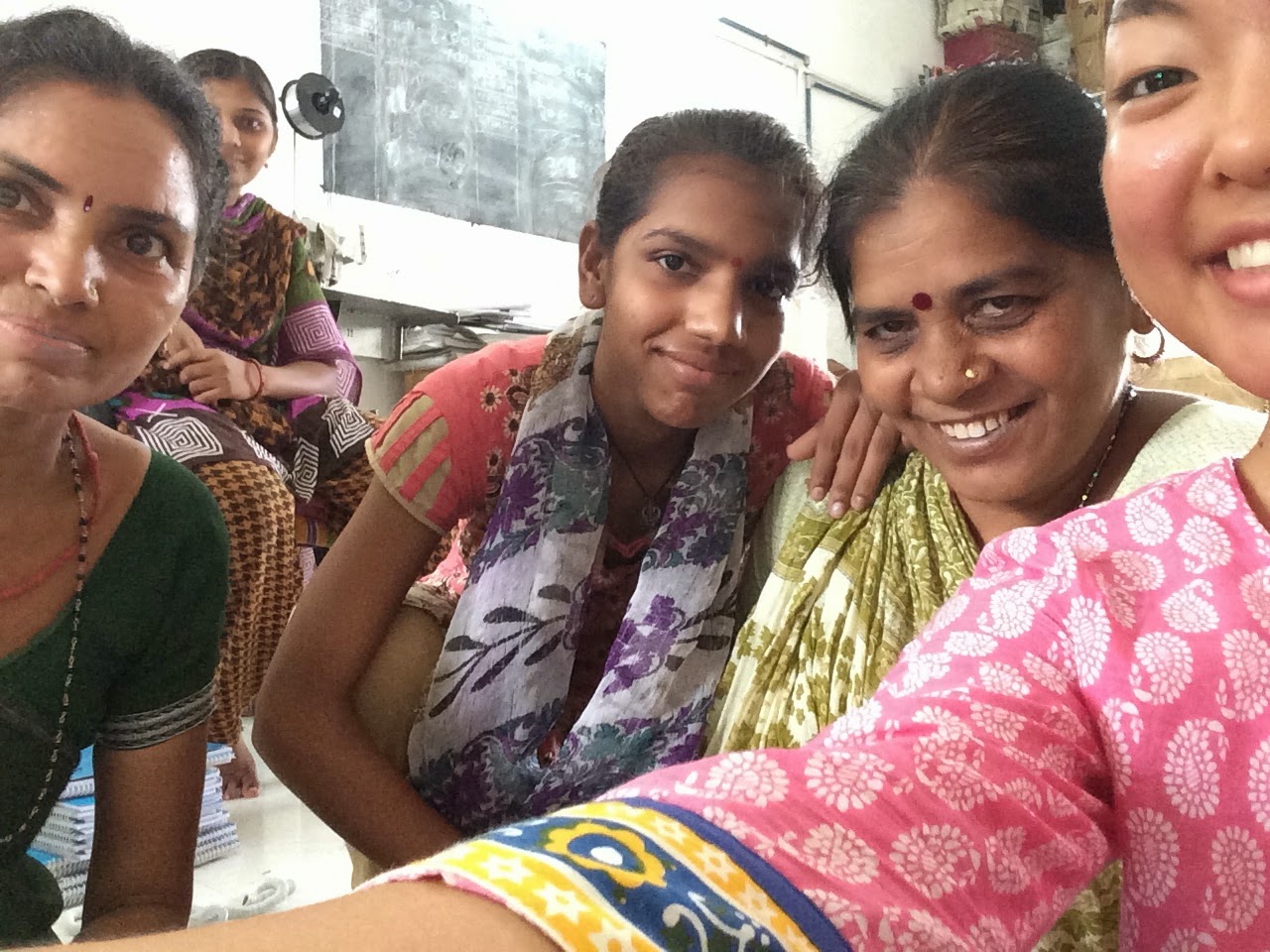
Jamie Kim and SEWA coworkers

The first few days here were quite chaotic. I now feel that I have settled in and am able to write about the work I am doing here in Ahmedabad at SEWA, the Self-Employed Women’s Association. I would have liked to describe the logistics of this trip, such as my accommodations and hostel-mates, but I am trying to avoid making this entry longer than it has to be.

During the first week, SEWA gave the interns an orientation and introduction to some of the different sectors and their respective offices. SEWA was established in 1972 and has more than 1.3 million women members who seek stability and self-reliance through employment. This sort of employment ensures that these women receive security and benefits, both of which were not received in the members’ prior work. SEWA also extends to the SAARC countries of Afghanistan, Bangladesh, Bhutan, Maldives, Nepal, Pakistan, and Sri Lanka. After visiting the offices and learning more about SEWA’s progress, I was enthused to be working with such a forward-thinking non-governmental organization.

Today was my third full day of work at Gitanjali, SEWA’s branch for stationery creation. Gitanjali was formed in 1995, and its objective is to supply an alternative livelihood of various paper products through recycled paper waste incorporation while providing a more sustainable career for women workers. Many of the employees of Gitanjali are also working as “waste-pickers.” As waste-pickers, these women are exposed daily to poor sanitation and the danger of cuts leading to diseases. Women more oftentimes fear suffocation from heaps of waste burying those working at the bottom. Gitanjali has helped organize waste-pickers and provide opportunities for women to develop skills in creating handmade stationery products out of recycled materials. With continuous orders from companies like Staples, Accenture, and Goldman Sachs, Gitanjali has developed immensely. During these first few days, I have been observing the production line and the 30 employees at Gitanjali. My assignments are to produce case studies of the women, create marketing materials, examine the finances, and identify operational deficiencies. I am dumbfounded by each story I am told and more and more amazed at the work SEWA is doing.

In regards to living in India, it has been quite nice. Along with the other interns, I am living in EDI’s (Entrepreneurship Development Institute of India) International hostel. I am blessed with air conditioning, single room, private bathroom, cleaning service, laundry service, and WiFi. I came with the idea that I would lose weight but have put on a few pounds instead, due to the lavish plates of authentic Indian food provided on campus. I did not expect such comfortable accommodations and am extremely grateful. The students attending the institute have also been very welcoming and helpful. If only the heat would be more kind…

-Jamie Kim

Kandyce Graber, London Internship—Econ & Finance Track

Kandyce_Big Ben

Interned in Economic Consulting at Europe Economics, Spring 2014

Internship: I worked at a firm called Europe Economics. They do economic consulting for an array of European clients. In fact, two of their largest clients are the European Commission and the European Parliament. I did various different research projects, from browsing news stories on Bloomberg to researching supply chains. I also drafted reports, created excel files, and made phone calls.

I Learned: I learned a lot about Europe, its structure, and its governing bodies. I think this was due to my internship and the amount of research that I did in relation to the European Commission. However, much of what I learned is not tangible. I learned about the culture of London and other European cities. Further, I learned what it is like to live so far away from home and not to be able to rely on your parents. It is a big change, but it is absolutely worth it.

What Surprised Me: I had heard from so many people that London is “not European.” Many people say that it has become very American. Because of this, I wasn’t expecting culture shock, but when I got to London that all changed. While the differences between London and American cities are not huge, they do add up. When I was in London, I wrote a blog and I even posted an entry called “Subtle Differences,” which mentioned some of the things that people don’t tell you will be different, but end up being different.

Hardest Part: As I just mentioned, I was surprised with the culture shock. Because of this, I did go through a period of home-sickness. However, there was so much to do to keep me busy and to keep my mind off home, that I quickly got over it. I’m sure many people experience something similar to what I did. It is natural, but it definitely shouldn’t prevent someone from such an amazing experience.

Best Part: I think the best part of my experience was simply learning about all of the different cultures. The world has so much to offer, and until you experience it for yourself, you can’t quite grasp that. Also, I have to say, I took a class called London Architecture and Urbanism, and it was incredible. I was able to learn so much about London and its history, and I would definitely recommend the class to anyone.

My Tips:

  • Have an open-mind to cultural differences. You are only there for a short time, and you should embrace it.
  • Create a budget. London is expensive, but if you budget, you can do/see a lot of cool things without being too stressed about money.
  • Take advantage of London. There is SO much to see, and unfortunately it isn’t possible to see everything in the time you are there. Before you leave, think about some of the most important things on your must-see list and do them early!
  • Take advantage of Europe. There are 4 airports that are fairly easy to get to from London, so that means you have tons of flight options. Ryanair and Easyjet are cheap so be sure to check out some other cool European cities!
  • Visit the British Museum! This was my coolest site in London and it is huge! If you are planning on going, give yourself tons of time


Alexa Tom, Madrid Internship

Interned in Hospitality and Event Planning at Cat’s Hostel, Spring 2014Alexa Madrid Hostel

Internship: Twice a week I interned at Cat’s Hostel in the city center of Madrid. Some of the requirements I had to do were check guests in and out and manage room reservations, and also plan weekend events and parties for guests. For Valentine’s Day, we made invitations for every guest inviting them to a sangria fountain party in our lobby that included typical Spanish tapas. I loved my internship because hostels are very laid back. Also, my coworkers came from Spain, Italy, Argentina, and France, so I learned a lot about their backgrounds and got to spend time interacting with guests as well. 

I Learned: Two things I learned from this experience were one, really emphasizing the fact that knowing more than one language is a huge advantage in any situation whether it was traveling outside of Spain or in my case, during my internship where I worked in a hostel and people from all around the world were coming to stay. The second thing I learned was—while the norm for most people my age in the United States is to go to a university, maybe go to grad school, and then eventually work—there are also tons of young people meandering around the world before or after their studies. These people have learned so much about other cultures and lifestyles and really being open to adventure, which I’m definitely envious of since sometimes we can be so focused on ourselves and working nonstop, not taking the time to step out of our bubbles.

What Surprised Me: What surprised me the most about my time abroad was how the crisis in Spain has really affected the majority of Spaniards. Students continue to study until their late twenties if they want to be successful in the future, and many students usually study close by to home and still live with their parents to save money, but in turn this makes the family connections in Spain much stronger than in the US.

Hardest Part: The hardest part of my experience was managing time between traveling and exploring and studying. There are so many festivities, events on the weekdays, places to visit in Madrid as well as cheap weekend getaways to nearby countries, but it’s important to know that classes come first. All my classes covered my CAS requirements and were all taught in Spanish, so the variety of themes in my classes were very interesting, and I could use what I learned in class to understand the Spanish culture even more. 

Best Part: The best part of my experience was getting to know native people! I LOVED my host family, a mom and her daughter my age, and still keep in contact with them. Not only were they the sweetest, most caring people ever, but also I was forced to practice Spanish every single day. It’s definitely improved. I became friends with other native people in studying in Madrid, and I learned the most from them by just talking and comparing the different cultures, and experiencing their everyday lifestyle. Spanish people are so loving and welcoming, greeting someone with a kiss on both cheeks was much warmer than a handshake. 

My Tips: The main tip I have for those studying abroad is to try everything! From food (even when you have no idea what it is when you order it), not being afraid to talk to Spanish people, and really branching out to not only discovering the main attractions, but also wandering and getting lost in the city. There’ll be times when you miss home and American lifestyle, but you have to be open to how life is in Spain and adjust to their customs to make the most of your experience.